Simple Minecraft Survival House Builds Put Practical Footprints Over Mega Bases
New survival build guides showcase how compact, well-measured houses give Java and Bedrock players safe, stylish bases without weeks of grinding.
Minecraft News
Survival players across Minecraft Java Edition and Bedrock Edition are increasingly stepping back from exhausting mega mansions in favour of compact, cosy homes built around smart room geometry. Fresh layout breakdowns published by minebuildr.com alongside creator roundups from THESPIKE highlight a clear shift toward manageable starter bases that work from night one and expand cleanly over time.
The practical appeal starts before a single wall goes up. According to minebuildr.com, the biggest mistake survival builders make is misjudging interior clearance once walls are placed. Because standard rectangular walls consume two blocks along both width and length, laying down temporary corner markers on flat ground near existing resource nodes lets players test whether beds, chests, and furnaces will jam the front doorway before committing to a roof.
Tested Footprints for Early and Mid-Game Bases
Rather than treating early shelters as disposable dirt boxes, modern layout guides break starter homes down by resource availability and terrain. Players racing the first sunset can carve a 5×5×3 chamber straight into a hillside using almost zero gathered wood, later dressing the entrance with a stone arch and digging side rooms while leaving thick natural rock toward the slope. Travellers needing a quick camp can throw up a 5×5 plank shell—leaving a tight 3×3 interior—by pushing crafting stations under an outdoor slab awning and keeping the hut later as a mining outpost.
| Build Style | Outer Footprint | Usable Interior | Best Survival Role |
|---|---|---|---|
| Travel Outpost | 5×5 | 3×3 | Temporary camp or mining checkpoint |
| Classic Oak Starter | 7×7 | 5×5 | First permanent single-room home |
| Stone or Woodland Cottage | 7×9 | 5×7 | Split sleeping and crafting corners |
| Expandable Homestead | 7×11 | 5×9 | Growing storage without moving house |
| Workshop Cabin | 9×9 | 7×7 | Heavy crafting and chest organisation |
| Courtyard Property | 11×11 total | 7×7 rear house | Enclosed front yard for outdoor workstations |
Once basic tools are secured, 7×7 and 7×9 footprints do most of the heavy lifting. A 7×7 oak-and-cobblestone cabin offers a reliable 5×5 room that can grow via a rear storage annex without tearing down the original entrance or roof. Miners returning with chests full of cobblestone can stretch to a 7×9 stone-walled rectangle textured with stone bricks, gaining separate sleeping and smelting corners on a single level. That same 7×9 base adapts easily into a bright woodland cottage pairing pale birch walls with a dark spruce roof, or a practical farmhouse joined by a simple porch to a fenced crop patch and composting corner.
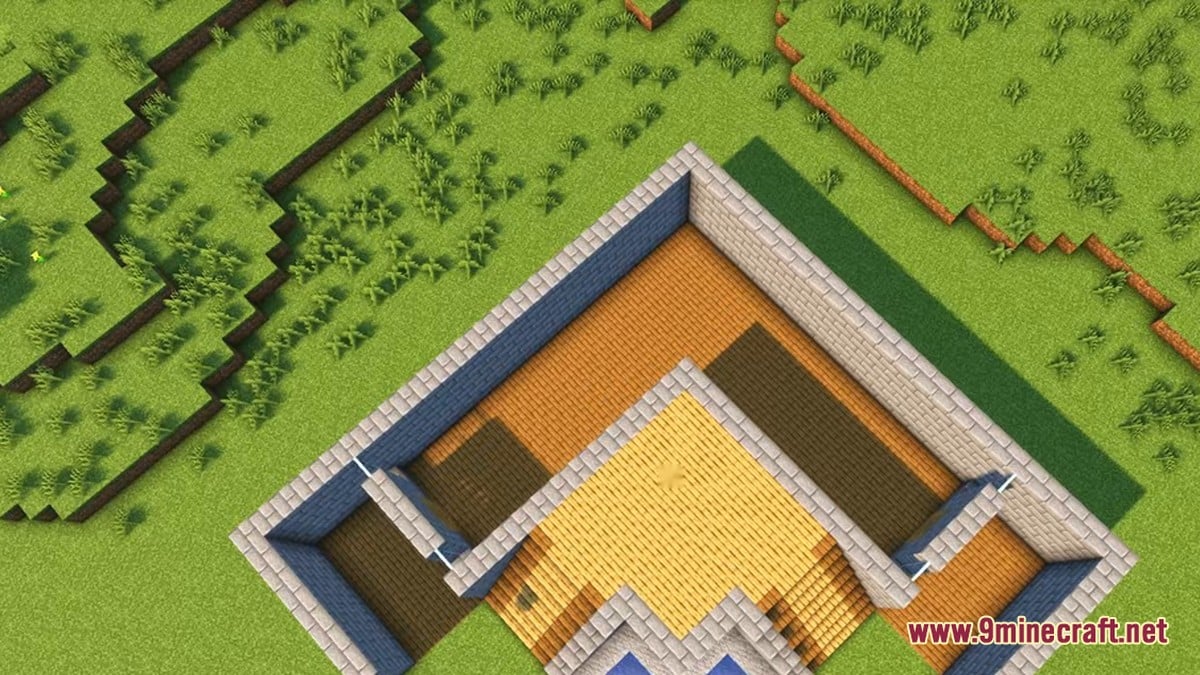
Location-specific builds rely on small attachments rather than massive shells to establish character. Along rivers and lakes, minebuildr.com points to a 7×9 cabin paired with a 3×7 shoreline deck, or a compact 5×7 fishing hut fronted by a 3×5 dock detailed with barrels, fences, and trapdoor nets—reminding players to expand inland first rather than wrestling with deep water early on. Forest builders can set a 7×7 cabin atop a 9×9 tree platform kept at a sensible height with fenced edges and lanterns, while players who want outdoor workspace can map an 11×11 plot housing a 7×7 rear cottage behind a walled courtyard.
 Cherry PlanksAdded in 1.20; suits 7×7 cottages on muted stone foundations.
 Mud BricksAdded in 1.19; earthy alternative where local stone is scarce.
 Dark Oak LogFavoured in multi-room rustic cabins for rich framing.
 Spruce StairsGo-to roofing block for tall 9×9 A-frames and birch homes.
 White ConcreteClean structural staple for sleek, modern survival bases.
 LanternEssential perimeter and beam lighting to block mob spawns.
None of these layouts require add-ons or redstone contraptions. While cherry and bamboo wood sets require Minecraft 1.20 or newer—and mud alongside mud bricks arrived in Minecraft 1.19—players on older versions can swap in local oak, spruce, or birch with flowers to capture a similar cottage mood.
What Creators and Survival Players Are Saying
In a companion roundup written by Eray at THESPIKE, community video tutorials echo this focus on compact efficiency while scaling upward for multiplayer and late-game storage. MarchiWORX champions low-cost wood-and-stone starter homes dressed up with sloped roofs and small porches, while Bradmall integrates survival security directly into the architecture using raised platforms, perimeter fences, large windows for natural daylight, and built-in crop plots so players rarely need to step into danger.
For builders outgrowing single rooms, SheepGG demonstrates both a compact two-bedroom dark oak house suited for co-op worlds and a sturdier multi-floor stone-and-dark-oak home that keeps smelting and crafting on the ground floor with beds upstairs. EWEN scales that same split-level logic into a larger long-term wood-and-stone base softened by greenery, whereas HelpToons ditches rustic timber for concrete, wide glass panes, outdoor seating, and rooftop gardens to prove modern minimalism still works in survival mode.
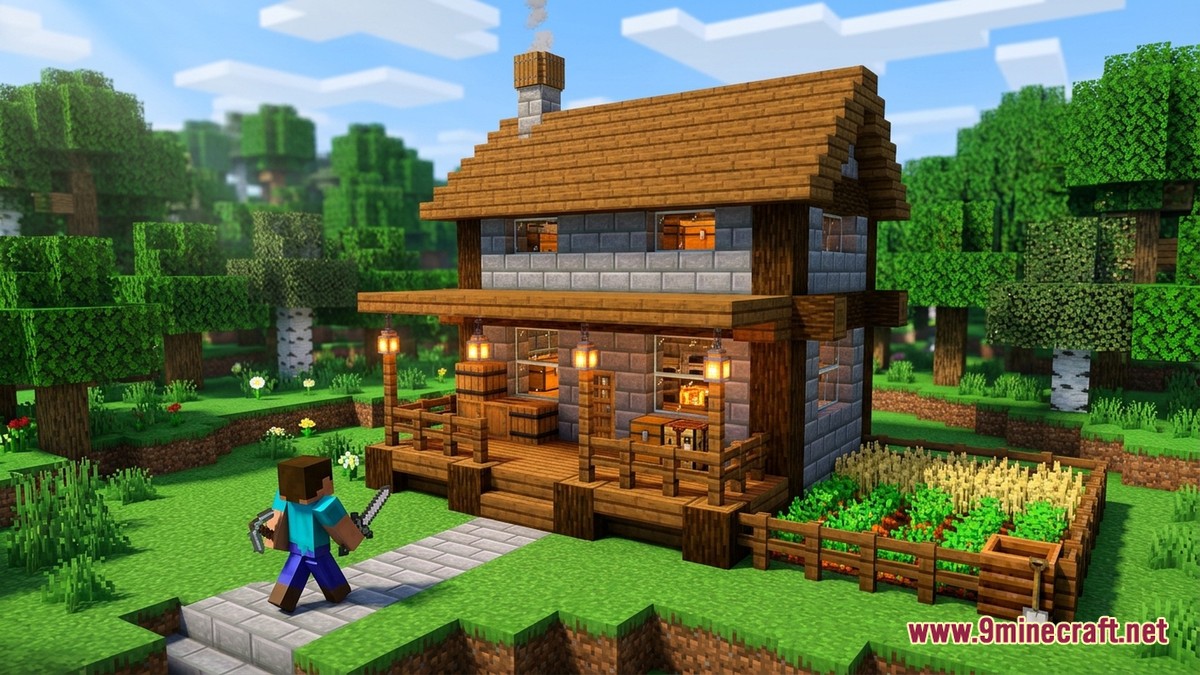
Community feedback around starter tutorials remains enthusiastic about cosy builds that respect a player's time, though experienced builders consistently warn against several common layout traps. Players frequently point out that adding an upper loft to a 9×9 spruce A-frame ruins the usable headroom underneath, and squeezing full staircases into 7×9 two-storey homes eats up too much floor space compared with using a ladder or widening the shell to 9×9. Veteran survivalists also push back against false security: cobblestone walls will not stop a creeper blast if the front path lacks visibility, courtyard walls still let mobs spawn inside without proper torch or lantern coverage, and lining up bare hoppers in a 9×9 workshop will not automatically sort items without dedicated redstone filters.
Which Minecraft versions support all of these house palettes?
Most oak, spruce, birch, dark oak, stone, and concrete builds work in almost any version. You only need Minecraft 1.19 for mud bricks and Minecraft 1.20 or newer for cherry and bamboo wood.
How do I expand a small starter house without ruining the roof?
Build a 7×11 rectangle with repeated window spacing from the start, or attach a storage room directly behind the back wall of a 7×7 cabin so the front porch and main roof stay untouched.
Do stone walls or courtyards make a survival base mob-proof?
No. Stone resists fire, not creeper explosions, and enclosed yards or raised tree platforms still spawn hostile mobs unless every dark corner and entrance is thoroughly lit.
Trying These Builds in Your World
Players looking to test these palettes with the full roster of cherry, bamboo, and mud brick blocks can grab the game through our Android, iOS, Windows, patched and Java Edition download pages, covering Bedrock Edition (Android APK, iOS, Windows GDK, and patched builds) while Java Edition guides and files are available on the 9Minecraft wiki. Always back up existing survival worlds before upgrading versions or renovating your main base.
Which survival starter house style do you build first in a new Minecraft world?
Tap an option to vote