Minecraft Bedrock 26.3 Multi-Structure Seeds: Villages, Ancient Cities and Biome Changes
Updated Minecraft Bedrock seed tools and community lists reveal dense village clusters, stacked Ancient Cities, and biome changes in Bedrock 26.3.
Minecraft News
Seed hunters and mapping developers have rolled out updated catalogues and browser finders tailored for Minecraft Bedrock Edition up to the 26.3 (Wilderness Bound), 26.40, and 26.50+ releases. While players often search for a single lucky spawn, newer community lists and scanning utilities focus on multi-structure layouts that stack early-game Villages right alongside Ancient Cities, Trial Chambers, and Woodland Mansions. At the same time, recent biome additions mean a few older favourites no longer generate the way they used to.
Why Bedrock Multi-Structure Seeds Differ From Java
Cross-platform players still run into mismatched coordinates when copying worlds between editions. As chunkmaps.net and mcseedmap.com explain, both editions have generated matching Overworld biomes and terrain shapes from the same seed number since 1.18, yet ore veins, decorations, and structures remain separate. Bedrock calculates structure positions using a 32-bit Mersenne-Twister (MT19937) random generator paired with edition-specific regional salts, spacing rules, and dedicated stronghold lookups.
Because terrain viability checks happen last, mapping sites such as craftmc.net—which now defaults its Bedrock viewer to 26.3 (Wilderness Bound)—treat pins as placement candidates rather than guaranteed spawns. According to chunkmaps.net, even accurate local math covering Bedrock 1.18 through 26.50+ can sit off by a chunk or fail if a cliff or ocean blocks generation, so players should scout major targets in a fresh creative copy before committing to a long survival trek.
Java Edition Generation
- Shares Overworld biome layout and terrain height with Bedrock in 1.18+.
- Uses Java's own random seed engine and structure salt values.
- Allows routine travel above the Nether bedrock ceiling on standard worlds.
Bedrock Edition Generation
- Runs on Windows, consoles, Android, and iOS (formerly Pocket Edition).
- Places structures via a 32-bit MT19937 generator with separate spacing.
- Lacks standard Nether roof building, making protected Nether tunnels essential.
Dense Village Clusters and Early Progression
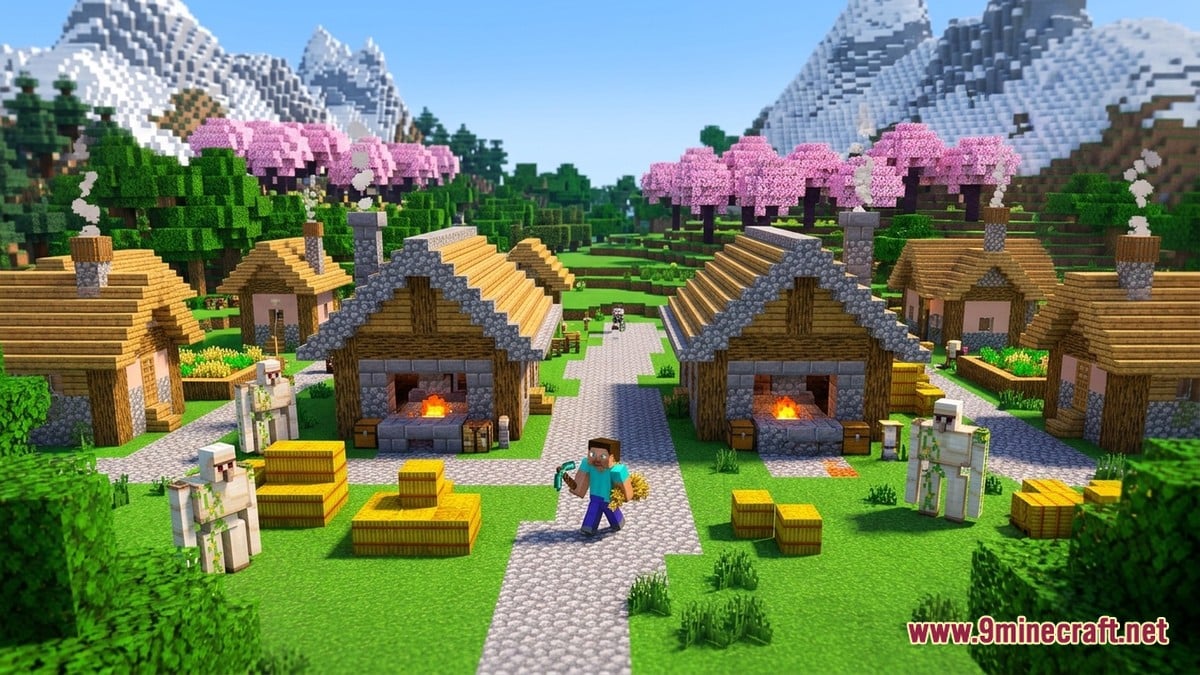
Starting beside multiple settlements solves several early survival bottlenecks at once. Using the cubiomes world-generation library, chunkscan.com filters specifically for Bedrock worlds featuring at least two villages within 400 blocks straight-line of spawn. Having two settlements side by side doubles your supply of hay bales, beds, workstations, and iron golems, while giving solo players and multiplayer groups enough librarians to reroll for Mending alongside farmers for quick emerald trades.
Several standout layouts go well beyond a simple pair. A catalogue of 36 community-tested seeds compiled by minespecs.com includes four Taiga Villages clustered at spawn, two oversized Snowy Villages built for a mega trading hall, four settlements nearly merging around a spawn lake near a Trial Chamber and ruined portal, and a massive hub packing ten villages within 1,050 blocks of spawn with an eleventh nearby. Meanwhile, gamingchill.com highlights a dual Plains Village spawn—originally surfaced by Pro Game Guides—where both towns contain blacksmith chests framed by meadows, forests, snowy slopes, and small Cherry Groves.
Unusual biome borders also create memorable surface bases. Players scouting through gamingchill.com and minespecs.com have documented a Taiga Village partly tucked inside a shallow cave above a mineshaft and Lush Cave, a Desert cove full of natural caves opposite a second coastal village and Desert Temple, and a Desert-Jungle border placing villagers beside a trapped Jungle Temple and underground Trial Chamber. Outpost combos add instant combat: one seed parks a Desert Village 40 blocks from a Pillager Outpost and temple, while another sets a mountainside outpost 190 blocks east of a Savanna Village with an Ancient City buried under the slope between them.
Stacked Ancient Cities, Trial Chambers, and Mansions
Underground structure overlaps have become the biggest prize for late-game explorers. In its Bedrock 1.21 to 26.40 seed breakdown, gamingchill.com points to a Plains Village resting beside a mountain range with five separate Ancient Cities underneath, plus a second mountain seed pairing a blacksmith village with four Ancient Cities. On minespecs.com, a Stony Peaks spawn hides an Ancient City almost directly under your feet on Bedrock—whereas the closest Java equivalents sit roughly 235 blocks out—and another seed generates a Trial Chamber vertically above an Ancient City.
Other generation quirks mash structures from different updates together. Explorers on minespecs.com found 1.20 Trail Ruins sitting directly atop a 1.21 Trial Chamber in a snowy taiga, a Stronghold intersecting a Trial Chamber, a pinned Stronghold 990 blocks from spawn (200 blocks south of a Jungle Temple), and five Trial Chambers scattered across a single jungle. Rare Woodland Mansion seeds also cut out thousand-block treks, featuring mansions sharing a sunken valley with a village, sitting above a Trial Chamber near spawn, or bordering a flooded canyon, Birch Forest, Lush Cave ravine, and Pale Garden sections.
 Enchanted BookReroll extra village librarians early for Mending trades.
 White WoolEssential for muffling footsteps around sculk sensors and shriekers.
 Trial KeyFarmed in bulk from jungle and snowy mountain Trial Chamber clusters.
 Diamond OreExposed in Badlands ravines, though veins can shift across patches.
Version 26.3 Breakage and Community Reaction
Across seed-hunting communities and tool builders, excitement over stacked dungeon layouts is tempered by frustration with silent world-generation shifts between minor drops. Testers on minespecs.com warn that moving from Bedrock 26.2 to 26.3 introduces dappled forest zones that overwrite specific Plains and Meadow settlements; one Meadow seed with three nearby villages loses its settlement at 344, -264 in 26.3, and a popular Cherry Grove valley loses its neighbouring Plains Village entirely unless generated on 26.2. Players on gamingchill.com also note that exposed Badlands ravine and Cherry Grove deepslate diamond veins shift far more easily across patches than surface landmarks.
Tool developers and veteran survivalists remain candid about Bedrock's practical limits too. Community guides routinely remind newcomers not to rush Vindicators in spawn Mansions or trigger the Warden without wool, food, and an escape route, while mcseedmap.com cautions that dividing Overworld X and Z coordinates by 8 requires digging a enclosed tunnel through normal Nether terrain rather than relying on the Nether roof. If you want to test these seeds on Bedrock 26.3, 26.40, or 26.50+—or keep an older 26.2 setup—back up your existing saves first, as test builds can crash; you can get the game via our Android, iOS, Windows, patched and Java Edition download pages, covering Bedrock Android APK, iOS, Windows GDK, and patched builds, alongside the 9Minecraft wiki for Java Edition.
Do Bedrock seeds work on Minecraft Pocket Edition?
Yes. As gamingchill.com notes, Pocket Edition is simply the older name for mobile Minecraft; modern Android and iOS builds run Bedrock Edition and share seeds with Windows, Xbox, PlayStation, and Switch on matching versions.
Can I get new Trial Chambers or 26.3 biomes in my existing 1.20 survival world?
Only in unexplored areas. According to mcseedmap.com, previously loaded chunks never regenerate new structures, and entering a seed only shapes brand-new worlds.
Why do some seed guides skip the Y coordinate?
Surface builds like villages only need X and Z because ground height is obvious, whereas caves, Ancient Cities, Trial Chambers, and diamond veins require all three coordinates to locate underground.
Which multi-structure setup do you look for first when starting a new Minecraft Bedrock survival world?
Tap an option to vote