Plakar Connector Backs Up Running Minecraft Java Servers Over RCON
Open-source developer Gilles Chehade has released a Plakar integration that pauses Minecraft world saves over RCON to capture clean backups without kicking players.
 9Minecraft Team
Server administrators can now back up live Minecraft worlds without kicking players offline or risking chunk corruption. Gilles Chehade, creator of the open-source backup tool Plakar, has released a dedicated connector that pauses world writes over RCON, takes a snapshot of the server folder, and resumes saving while everyone keeps playing. Alongside the practical tool, news.lavx.hu reports that Chehade also built an experimental storage backend that writes backup data directly into walkable terrain inside a Minecraft world.
Why Live Minecraft Backups Often Corrupt Worlds
Copying a server folder while Minecraft is running looks simple, but the game constantly rewrites region files as players explore and place blocks. According to github.com, grabbing files mid-write mixes chunks from different moments in time, creating a broken world that often stays hidden until an administrator tries to restore it months later. Traditional workarounds either shut the server down completely or rely on fragile shell scripts that wrap rsync around console commands.
Chehade solved this by extending Plakar's standard filesystem importer and exporter with RCON coordination. When a backup starts against a live server, the connector tells the console to flush pending data and pause auto-saving ("save-off" and "save-all flush"). Every block broken or placed while the snapshot runs stays safely in server memory, and once the file copy finishes, the tool re-enables disk writes so changes flush normally. If the server is already offline, the connector skips the RCON steps and backs up the directory directly.
Setting Up RCON Backups and Targeted Restores
As detailed on github.com, the connector lives in Plakar's development channel and can be installed with "plakar pkg add -devel minecraft", or compiled from the "integration/minecraft" branch on the poolpOrg/plakar-integrations repository using "make install". If readers want to try Java Edition to test their own local server setup, they can get it from the 9Minecraft wiki and download links on this page. To let Plakar talk to a running server, administrators must enable RCON in "server.properties" by setting "enable-rcon=true", "rcon.port=25575", and a password, while keeping the port on "localhost" or a private network since the protocol sends plaintext.
- Create a Plakar repository at your chosen backup path, such as "/var/backups/minecraft".
- Run `plakar at /var/backups/minecraft backup -exclude 'logs/**' minecraft:///srv/minecraft` to capture the server while skipping log files.
- Schedule nightly automated snapshots at 04:00 with cron using "-tag nightly".
- To recover a damaged map, stop the server first and run `plakar at /var/backups/minecraft restore -to minecraft:///srv/minecraft <snapid>:/srv/minecraft/`.
Because Plakar slices files into content-defined chunks and only stores new bytes, quiet region files outside active player bases cost almost no extra storage across months of nightly runs. Administrators can restore an entire machine, migrate a server directly from an S3 bucket ("s3://backups/minecraft"), or recover only the Overworld folder ("/srv/minecraft/world") if griefers blow up spawn.
| Component | Option | Default / Behaviour |
|---|---|---|
| Importer | quiesce | Enabled by default; pauses world saves via RCON before copying |
| Importer | timeout | 5 minutes per console exchange to allow large worlds to flush |
| Importer | dont_traverse_fs | Prevents the backup from following mount points under the server path |
| Exporter | allow_running | Lets admins restore closed files like plugin configs while live; unsafe for worlds |
| Exporter | timeout | 30 seconds for RCON checks during restore operations |
Storing Backup Files as Walkable Minecraft Terrain
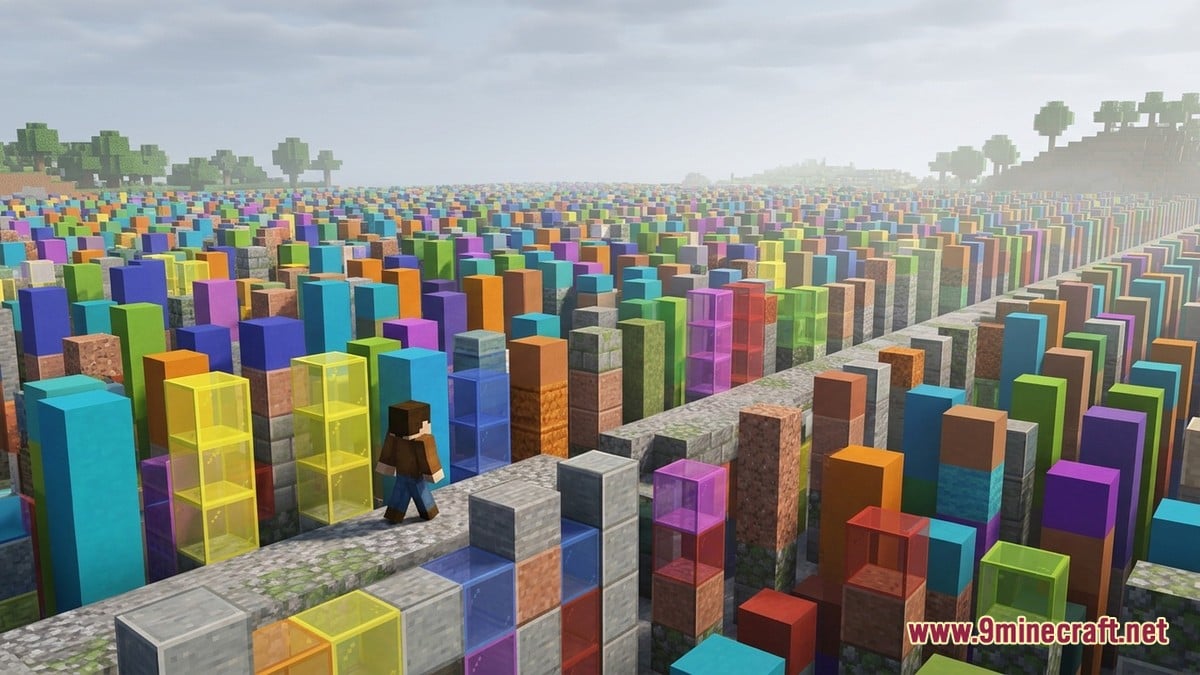
Beyond protecting servers, news.lavx.hu notes that Chehade built a second experiment that turns a Minecraft world into the actual hard drive holding Plakar backups. Plakar's storage engine, Kloset, only requires a backend to store and retrieve packfiles and states by content address, serve byte ranges, list contents, and delete data. Chehade wrote a custom codec that translates raw backup bytes into terrain columns across region files, choosing a walkable landscape over dense 3D block packing so players can stroll across their own data.
 StoneUsed alongside coloured blocks to map 3 nibbles of colour data per column
 Stained GlassInert block type encoding byte values across walkable chunk columns
 TerracottaProvides distinct colour states for the 2-byte-per-column storage codec
 ConcreteForms durable, non-gravity terrain columns holding 512 bytes per chunk
Each world column stores two bytes of data: one nibble (4 bits) controls the column height, while three nibbles (12 bits) select block colours from stone, stained glass, terracotta, and concrete. At 16×16 columns, every chunk holds 512 bytes, with region headers arranged to track packfiles and states. To stop players or physics from scrambling the archive, the map forces Adventure mode, applies strict gamerules, and uses inert blocks, while Kloset hashes every read against its content address so a single altered block triggers a verification error rather than a bad restore.
How AI and Plakar's Engine Made the Connector Possible
Chehade created the integration in his spare time to prove that Plakar's 45 existing connectors can easily expand into everyday consumer and gaming tools. While news.lavx.hu states he used Claude Opus 4.5 and Chehade's own post on github.com credits Claude Opus 5.5, both accounts agree he fed the AI a single short prompt asking it to study "PlakarKorp/integrations" and build a round-trip tested Minecraft module. He verified the finished code against vanilla Minecraft 26.3 inside the "itzg/minecraft-server" Docker image, confirming that live backups paused saves, live restores were blocked, and a restored snapshot booted with the exact same seed and terrain.
Under the hood, the tool relies on years of storage engineering. On poolp.org, Chehade explained how testing Plakar on a cheap mechanical-disk server exposed heavy memory swapping and 400,000 separate "stat()", "open()", "write()", "close()", and "rename()" calls per backup, prompting him to adopt 20 MB packfiles, a repository index, and read/write semaphores inspired by git and restic. According to thekb.eu and plakar.io, the Paris-based startup—founded in September 2024 by Chehade and Julien Mangeard—raised $3 million in May 2025 from investors including Olivier Pomel and Solomon Hykes, passed a February 2025 cryptography audit by Jean-Philippe Aumasson (using Argon2id, AES-256-GCM-SIV, and BLAKE3), introduced the standalone ".ptar" archive format in June 2025, shipped Plakar v1.0.1 with a built-in web UI and free task alerting, and joined the Linux Foundation and CNCF in January 2026.
Community Reaction and Server Admin Feedback
Across developer forums and community discussions, server hosts welcomed a backup tool that refuses to take a broken snapshot when RCON is misconfigured, noting that homemade "rsync" and screen-scraping scripts frequently fail silently. Several administrators pointed out that unattended cron jobs still need external monitoring in case the backup process crashes before sending "save-on", and praised the visual Minecraft terrain store as a clever stress test of Kloset's content-addressed verification even if nobody should ever store production archives inside an Overworld.
How do you currently back up your Minecraft server?
Tap an option to vote