Minecraft Redstone Builders Share New Railguns, Wireless Relays and Circuit Tools
Redstone engineers have released new wireless relays, railgun schematics and a 2D circuit simulator to simplify complex Minecraft signal builds.
 9Minecraft Team
A new crop of community blueprints and web-based planning tools is making high-end Minecraft engineering much easier to build in survival worlds. Across several schematic libraries and circuit platforms, creators have published working wireless transmitters, heavy and micro railgun launchers, and browser simulators for multi-state signal lights.
Instead of spending hours troubleshooting broken timings by hand, players can now preview component orientations layer by layer or test pulse logic before placing a single block. Together, these releases bridge the gap between massive technical showcases and compact contraptions that fit neatly inside a starter base.
From Heavy Obsidian Railguns to Micro Launchers
Projectile launchers remain one of the most popular challenges in technical Minecraft, and two recent releases show just how differently builders approach the concept. According to MineSchematic, creator selim5151 designed a Railgun Redstone Cannon tailored for Java and Bedrock Edition 26.2, while maintaining compatibility back to 1.17 and nearby versions. Measuring 19 × 16 × 13 blocks, the vanilla contraption packs 835 blocks across 24 block types, relying heavily on Obsidian, Dispensers, Observers, Pistons and Redstone Dust in a 63.6 KB blueprint.
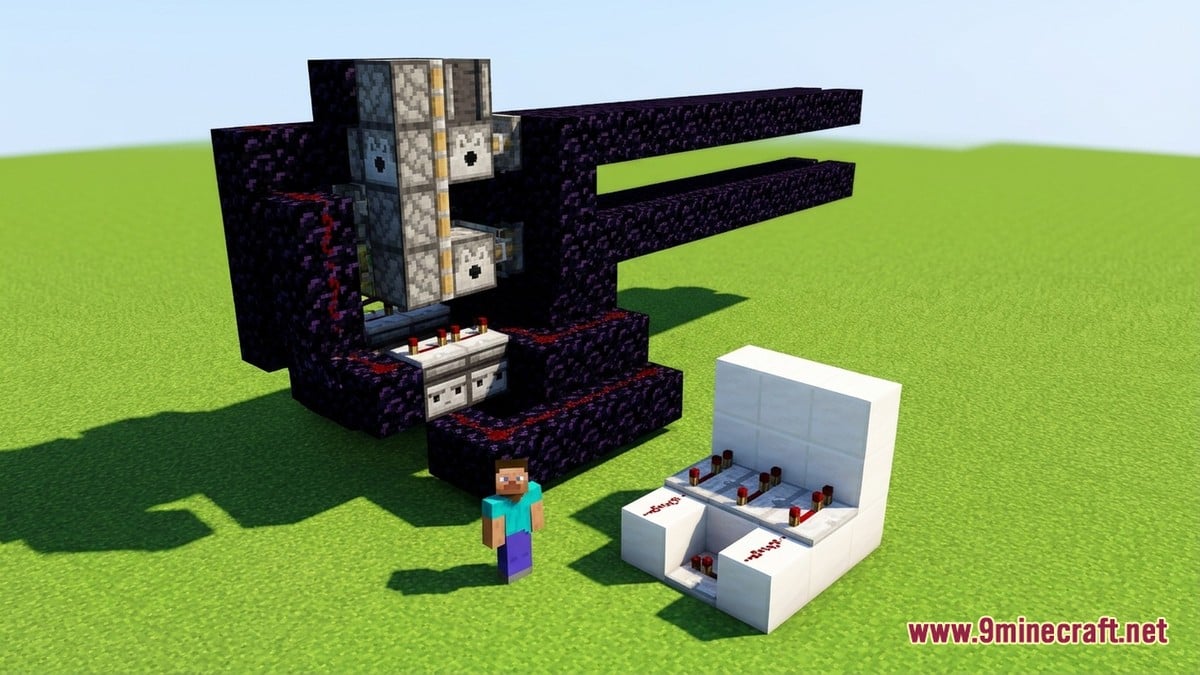
For players who want a far smaller footprint, Bloxelizer highlighted a compact RAILGUN build published by AmberFox509 for Java and Bedrock Edition 1.21.9 and newer. This micro design measures just 5 blocks wide, 3 long and 4 tall, requiring only 31 blocks across 11 block types. Its frame uses 17 White Concrete blocks alongside 3 Redstone Repeaters and 2 Redstone Wire pieces, making it inexpensive to assemble early in a playthrough.
High-damage arrow launchers are also gaining traction on dedicated file-sharing hubs. On Redstone Schematics, builders DavidDaxYT and KokoMaster_ showcased an arrow-firing railgun engineered to eliminate targets in a single hit along its flight path, packaged for quick sharing without modding the base game.
| Build Name | Creator / Source | Dimensions | Total Blocks | Target Version |
|---|---|---|---|---|
| Railgun Redstone Cannon | selim5151 (MineSchematic) | 19 × 16 × 13 | 835 (24 types) | Java & Bedrock 26.2 (1.17+) |
| Compact RAILGUN | AmberFox509 (Bloxelizer) | 5 × 3 × 4 | 31 (11 types) | Java & Bedrock 1.21.9+ |
| Wireless Relay System | Shulkr | 13 × 18 × 17 | Not specified | Vanilla Redstone |
Sending Wireless Signals With Sound and Water
Long-distance wiring often clutters underground bases, prompting engineers to find ways around physical dust trails. Shulkr detailed a self-contained wireless transmission assembly that bridges spatial gaps by pairing acoustic detection with water streams. Instead of stringing repeaters across chunks, the machine triggers musical notes and tracks item movement through water to relay pulses reliably.
The entire transmitter occupies a 13-block-wide by 18-block-high by 17-block-long volume. To protect the delicate internal water channels and sensors, the mechanism sits inside a thick Black Stained Glass cage, accented by White Stained Glass and Smooth Quartz Blocks that outline each functional module. Inside the casing, Stone Brick Wall segments divide the circuitry, while Smooth Quartz Stairs form clean entry points for maintenance.
 ObsidianBlast-resistant frame for heavy railguns
 DispenserCore firing block in cannon arrays
 Redstone ComparatorControls 1–15 signal levels for lights
 Redstone RepeaterAdds 1–4 ticks of delay and state locks
 Black Stained GlassNon-conductive shell for wireless relays
 White ConcreteMain structural block in micro railguns
Working Signal Lights and Browser Circuit Simulators
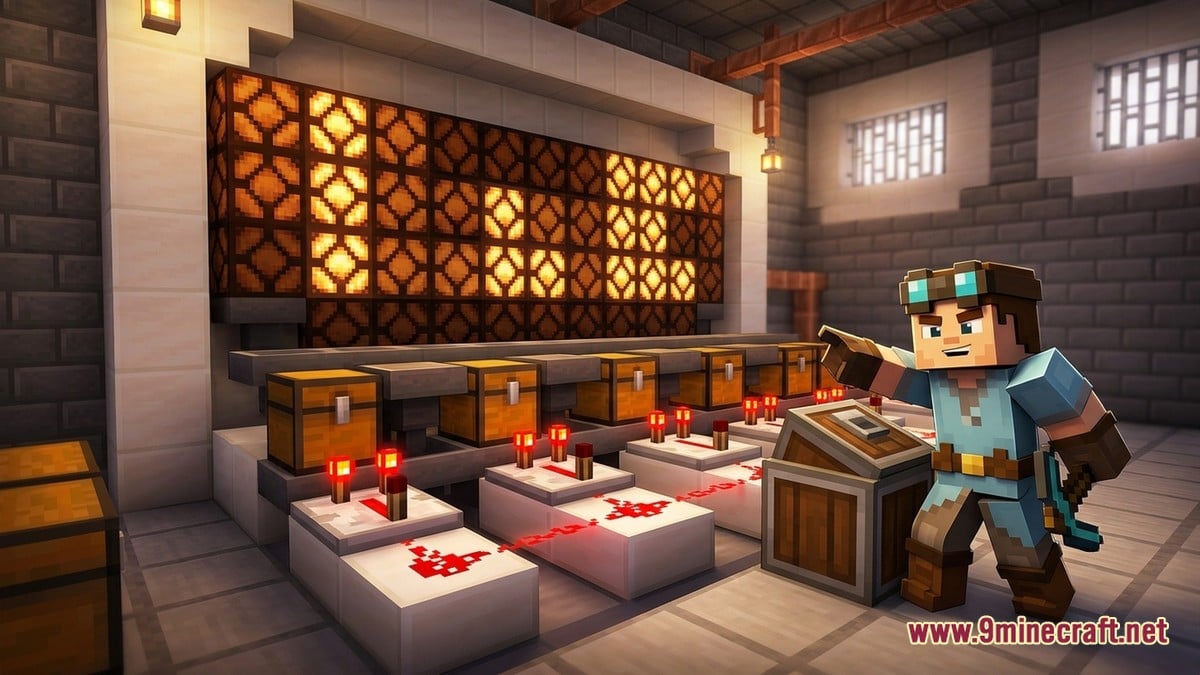
Building responsive indicator boards and working signal lights requires exact control over power decay. To speed up prototyping without survival lag, CraftMC launched a browser-based 2D simulator modelled on Java Edition redstone rules. Players can place Redstone Comparators in subtract mode alongside chests holding specific item counts to output exact signal strengths between 1 and 15, driving multi-state Redstone Lamp patterns, scoreboard counters and indicator doors.
The tool visualises subtle power rules that frequently trip up newcomers. Full blocks such as stone, wool, slime and lamps can be soft-powered to trigger neighbouring components without energising adjacent dust, whereas Glass, Honey Blocks, doors and trapdoors remain non-conductive. Engineers can also model side-powered repeater locks for memory cells, observer clocks, torch burnouts and quasi-connectivity, where Pistons and Droppers respond to powered blocks 2 spaces above them.
Because 1 redstone tick equals 2 game ticks or 0.1 seconds, even a 1-tick comparator or observer pulse can throw off a sequential build. CraftMC lets users pause execution, step forward one tick at a time, and export large layouts as JSON or PNG files without storing circuits on external servers. Meanwhile, companion reference tools like WBuilds focus on numbered placement sequences and exact block orientations so builders do not misplace directional components in 3D space.
What Creators and Players Are Saying
Across build showcases and community threads, reception to cleaner schematic tools and pre-tested blueprints has been largely enthusiastic. Creators point out that major social boards like Reddit block direct uploads of .schem and .litematic files, which explains why lightweight hosts such as Redstone Schematics have become popular for sharing arrow cannons and farm modules without intrusive adverts. Survival players also appreciate testing comparator chains and piston timings in a browser before farming stacks of quartz and obsidian.
At the same time, experienced redstone veterans raise practical caveats. Players note that 2D browser grids cannot fully replicate three-dimensional vertical wiring quirks or complex in-game lag behaviour, meaning massive cannons still require live world testing. Cross-edition builders also warn that Java and Bedrock handle quasi-connectivity and update order differently, so schematics tagged for both editions sometimes need minor repeater adjustments depending on your game version.
How to Import Schematics and Test Safely
If you want to try these contraptions in-game, Java Edition players can drop .litematic files into their schematics folder for block-by-block holographic placement with Litematica, or paste .schem files directly using WorldEdit commands. On Bedrock Edition, players can import .nbt or .mcstructure files through in-game Structure Blocks.
Always back up your survival worlds before firing high-speed railguns or running rapid redstone clocks, as misfires and entity spikes can damage nearby builds or cause crashes. If you need to install or update the game to match compatible versions like 1.21.9 or 26.2, you can grab Bedrock Edition (including Android APK, iOS, Windows GDK and patched builds) from our Android, iOS, Windows, patched and Java Edition download pages, or visit the 9Minecraft wiki for Java Edition.
Do redstone railgun schematics require gameplay mods to work?
No. The mechanisms themselves use vanilla blocks like dispensers, observers and repeaters, though Java players often use Litematica or WorldEdit to place the blueprint.
Why do glass and doors block signal light circuits?
In Java Edition rules, glass, honey blocks, doors and trapdoors are non-conductive; doors activate when powered, but none of them pass soft power to adjacent mechanisms.
Will a Java redstone schematic always work identically on Bedrock?
Not always. Simple repeater layouts often work on both, but builds relying on Java quasi-connectivity or 1-tick piston behaviour may behave differently on Bedrock.
Which type of redstone project are you most likely to build in your world next?
Tap an option to vote