Developer Runs Minecraft Server Login on 1960s UNIVAC 1219B Military Computer
Machine learning developer Nathan Farlow and collaborators got a Minecraft login server and NES emulator running on the world's only working 1965 UNIVAC 1219B.
 9Minecraft Team
Machine learning developer Nathan Farlow and a team of retro-computing collaborators have successfully hosted a Minecraft server login on a 1960s UNIVAC 1219B mainframe. As detailed on farlow.dev and documented in a video by creator TheScienceElf, the eight-month project connected a modern laptop to the sixty-year-old naval machine over a serial PPP/TCP link to complete a server handshake.
According to The Financial Standard and Hackaday, the software did not run a full playable world, as the hardware is far too slow for real-time block updates. Alongside the Minecraft login server, daily.dev reported that the group also ran a working NES emulator ("smolnes"), a web server, OCaml applications, AES encryption, a BASIC interpreter, and teletype overstrike ASCII art on the same machine.
Inside the 1965 Naval Mainframe
The Financial Standard and news.e-ink.me noted that the UNIVAC 1219B was built around 1965 for US Navy destroyers and cruisers to read radar inputs and direct artillery fire. Only two units survive today after being rescued from Johns Hopkins University by volunteers from the Vintage Computer Federation (VCF): Duane, Bill, and Steven, who spent ten years restoring the sole working model.
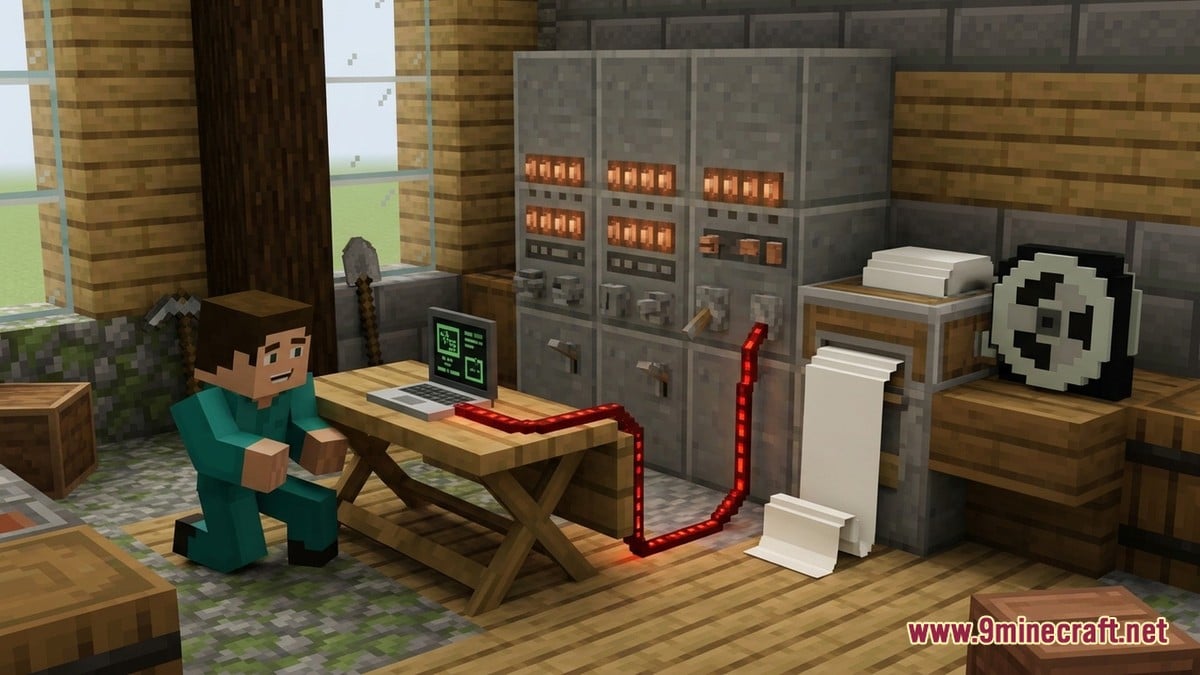
Interfacing with the cabinet requires a physical paper teletype that handles both typed input and printed output on the same roll, sitting next to a semi-functional magnetic tape unit. Hackaday and The Financial Standard pointed out how hostile the internal design is to modern code: it uses 18-bit words (rather than a power of two), a single 36-bit register alongside an 18-bit register, banked memory with a 2-microsecond main cycle time (500-nanosecond control memory), and ones' complement arithmetic complete with a signed negative zero.
How They Got C and Minecraft Code onto 18-Bit Hardware
Farlow first saw the machine running hand-written assembly demos at VCF East in April 2025 and decided to get a C compiler working on it. As he explained on farlow.dev, his initial test used his own minimal instruction set project called wee, which proved unusable when a basic FizzBuzz script consumed 27,000 words (67% of the machine's memory) and took a full minute to print 100 lines.
Building a custom GCC or LLVM backend directly for the UNIVAC would have left C integers as 18-bit ones' complement numbers, breaking modern off-the-shelf software that expects 32-bit two's complement math. Instead, Farlow compiled C code to standard 32-bit RISC-V using GCC, and hand-wrote a RISC-V emulator in roughly 1,000 lines of UNIVAC assembly covering 38 base RISC-V instructions.
| Metric or Task | Before / Unoptimised | After / Final Result |
|---|---|---|
| Emulator Speed (Rust vs VB.NET / Hardware) | 1x on real UNIVAC (VB.NET was 100x slower) | 400x faster than hardware (40,000x faster than VB.NET) |
| Instruction Overhead | 27,000 words for FizzBuzz using 'wee' | ~40 UNIVAC instructions per 1 RISC-V instruction |
| Instruction Pre-Encoding Speedup | Scrambled 32-bit RISC-V immediates | 30x overall speedup via two 18-bit word re-encoding |
| NES Emulator (Pinball 1st Frame) | 20 hours estimated on real hardware | 40 minutes on the museum UNIVAC |
Before writing that assembly, the team needed faster development tools than Duane's older QBASIC assembler and VB.NET emulator. TheScienceElf explained in the Hackaday discussion that running the old workflow on Linux required mounting files into DOSBox on every single test, which prompted him to write a new Linux-native assembler and emulator in Rust while stuck on a train.
To reach a 30x speedup, Farlow pre-processed every 32-bit RISC-V instruction into two 18-bit UNIVAC words ahead of time. This re-encoding unscrambled RISC-V's split immediate bits, assigned clean opcode numbers, pre-multiplied values like "immediate * 2", and even embedded ready-to-run UNIVAC shift instructions into the payload for variable shifts ("SRLI" and "SRAI") so the machine could write them to RAM and execute them on the fly.
Where AI Helped and Where It Failed
According to farlow.dev and daily.dev, Farlow used Claude Code heavily for tooling: the AI generated an Emacs major mode with syntax highlighting and instruction timing tooltips from scanned manuals, and later ran parallel subagents for micro-optimisations. However, when asked to write the actual UNIVAC assembly, the LLM repeatedly failed even when hooked up to the emulator and a differential fuzzer.
The AI could not cope with the 1960s machine's weird rules—such as left shifts being circular while right shifts are arithmetic, ones' complement edge cases, and the "CPAL" instruction behaving differently around zero. Farlow ended up writing all 1,000 lines of assembly by hand over a few days, relying on his software tracer, differential fuzzer, and test-case minimizer (which he also repurposed to strip dead code) to catch a memory address translation bug.
Community Reaction and Criticisms
Response across Hackaday and YouTube has been a mix of admiration for the hardware restoration and debate over how the Minecraft feat is described. Visitors who attended VCF East praised the live demonstration in Wall, New Jersey, calling the sight and sound of the operational mainframe well worth the trip.
At the same time, some readers on Hackaday pushed back against headlines calling it a full Minecraft server, pointing out that the real technical achievement is the hand-written RISC-V emulator and that only the login handshake actually ran. Other veteran engineers chimed in to explain why 18-bit and 36-bit words made perfect sense in the 1960s: before 8-bit ASCII took over in the late 1970s, computers widely used 6-bit BCD character sets (or 5-channel teleprinter codes on British machines like the 39-bit Elliott 803), and old serial protocols like SLIP had long paved the way for IP connections over serial lines.
What part of the UNIVAC 1219B project do you find most impressive?
Tap an option to vote