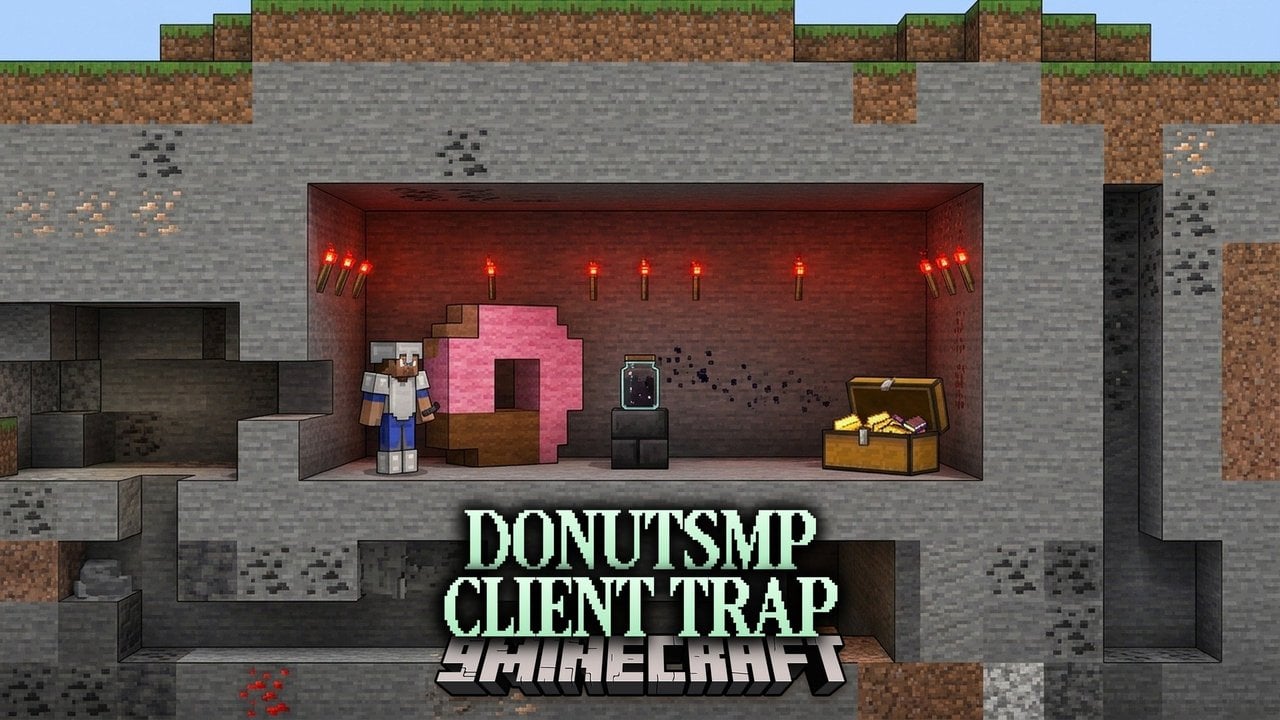
Minecraft Donut SMP Money Farms Ranked by Real Profit vs Revenue
New economic breakdowns for Minecraft's Donut SMP reveal why high-revenue crafting machines often lose money while modular kelp and villager setups thrive.
 9Minecraft Team
Players chasing quick riches on Donut SMP are discovering that massive sales payouts often hide substantial financial losses. Recent testing across the server's economy shows that raw resource generation and carefully discounted villager trades reliably outperform automated crafting setups that rely on purchased ingredients.
Currency dictates every aspect of survival on the server, funding shards, replacement gear, and base repairs after raids. As seasonal shifts and major patches alter the economy, guides from elyxir.gg, donutorders.com, donutschematics.com, and blockpatch.org have mapped out which income methods actually leave players with positive margins on Minecraft 1.21.
Why High-Revenue Crafting Machines Lose Money
A major mistake among builders is confusing gross sales revenue with net profit. In a four-way operational test conducted by elyxir.gg, machines that process bought materials into finished goods generated the largest headline payouts but exposed builders to severe margin traps.
The most prominent example is the automated shulker box crafting machine, which consumes two bought shulker shells and one chest per unit to fill player orders. During a single batch test, the setup brought in roughly 2.7 million in reported sales, leading all tested builds in pure turnover. However, because that figure does not deduct the hefty upfront bill for purchasing shells and chests, scaling the machine when ingredient prices spike simply multiplies the owner's losses.
The automated bone block crafter demonstrated an even clearer deficit. The machine feeds purchased bones through hoppers and two crafting stages—turning one bone into three bone meal, and nine bone meal into one block, meaning every finished block requires three bones. At an example buy price of 65 per bone, the raw ingredient cost hits 195 per block before factoring in the redstone hardware. In the elyxir.gg trial, spending roughly 1,000,000 on bones returned only 500,000 in sales, resulting in a 500,000 net loss.
- Shulker Crafter (Batch)2.7e+06 Currency
- Modular Kelp (10 min)1.136e+06 Currency
- Bone Block Crafter (Batch)500000 Currency
- Enderman Pearls (10 min)124000 Currency
Self-Sustaining Farms: Kelp and Endermen
To avoid ingredient costs entirely, experienced players build farms that generate their own raw items. According to elyxir.gg, a modular kelp setup divided into five separate stations—grouped in sets of two and three—yielded roughly 1.136 million in sales from a single ten-minute collection (850,000 from the first section and 286,000 from the remainder). Building smaller, independent modules allows players to verify that a redstone layout works on the server before repeating the build.
On a smaller scale, an Enderman grinder uses an endermite as bait to lure mobs into a kill chamber where a player uses a Looting III sword and a lever-operated hopper system. While a ten-minute run filled several chests with ender pearls worth a modest 124,000, the true value comes from the experience orbs. By placing an enchanting station next to the grinder, players convert that experience into enchanted gear for the player market, treating the pearl payout as secondary income.
Even when a farm generates its own resources, such as a skeleton spawner feeding a bone crafter, elyxir.gg notes that players must compare the return of selling raw drops directly against the return of crafting them into blocks. The same strict accounting applies to compact snow farms and spruce log setups that process wood into slabs.
| Setup Type | Primary Inputs | Reported Sales | Key Operational Bottleneck |
|---|---|---|---|
| Shulker Box Crafter | 2 Shulker Shells + 1 Chest (Bought) | ~2,700,000 | Loose boxes jam collection paths and cause lag; requires working capital |
| Modular Kelp (5 Stations) | Self-generating crops | ~1,136,000 | Requires active buyer orders to clear high-volume storage |
| Bone Block Crafter | 3 Bones per block (Bought or farmed) | ~500,000 (on 1M cost) | Hopper speed limits and negative conversion margins on bought bones |
| Enderman Grinder | Endermite bait + Looting III sword | ~124,000 (Pearls only) | Enchanted gear margins depend on base item costs and enchantment rolls |
Navigating the Order Book and Villager Discounts
Producing items is only half the equation on Donut SMP; getting paid requires matching output with active demand. As explained by donutorders.com, typing /sell automatically fills existing buy orders listed under /orders, while donutschematics.com stresses checking /shop sell prices every season so players do not get trapped building last season's meta farm. Editorial tier lists on blockpatch.org rank these income streams by hourly profit and beginner accessibility, updating their rankings after major patches.
To help players gauge real market depth, donutorders.com tracks how many items are still wanted at 85% or more of the current top order price—showing exactly how much stock a farm owner can dump before crashing the price. In their market snapshot, gold farms that harvest gold nuggets and gold ingots from zombified piglins recorded the highest number of active buyers on the server.
 Bottle o' EnchantingOver 1 million wanted in buy orders; acquired exclusively via cured cleric villagers.
 Gold NuggetPrimary drop from zombified piglin gold farms, backed by the deepest buyer pool.
 Shulker BoxHigh-turnover crafted item that risks jamming collection hoppers if left unattended.
 Bone BlockCosts three bones per block; frequently loses money when raw bones are purchased.
For players who prefer trading halls over mob grinders, bottles o' enchanting boast massive liquidity, with over 1,000,000 bottles wanted across buy orders according to donutorders.com. Because experience bottles cannot be crafted or filled manually, players must level up a cleric villager to unlock the trade. The profit margin comes from letting a zombie infect the cleric and curing it with a splash potion of weakness and a golden apple, locking in a permanent emerald discount.
Base Security and Redstone Maintenance
Earning millions is pointless if a single raid wipes out a player's entire net worth. According to donutschematics.com, almost every bankrupt player makes the same fatal error: placing their farm, main storage, and valuable stash inside a single build with a visible entrance. The site outlines a strict three-part survival rule that holds up through every seasonal reset:
- Start with passive farms, and only upgrade to expensive spawner rooms once you have the gear to defend them.
- Split your infrastructure into three separate locations: the farm in one spot, high-value loot in a hidden stash, and a backup regear kit in a third location.
- Keep a liquid cash reserve for replacement armour and operating materials rather than pouring every payout into farm expansion.
Mechanical reliability is just as critical as raid defence. During elyxir.gg's shulker crafting tests, churning out large batches of loose boxes overwhelmed the collection system, causing items to get stuck on machine components and hurting game performance. Builders must inspect hopper bottlenecks, halt crafting before storage overflows, and rely on tested 1.21 layouts exported directly from the server—as donutschematics.com recommends—rather than guessing from five-year-old tutorials that break under current mechanics.
Community Reaction and Creator Analysis
Across community discussions and technical breakdowns, veteran builders are urging newcomers to stop treating ten-minute collection clips as guaranteed hourly income. Analysts point out that short showcase tests ignore real-world friction like buy orders filling up, ingredient shortages, full storage chests, and server lag.
Players have responded warmly to modular farm designs and realistic profit accounting, noting that transparent loss warnings—like the bone block deficit—save beginners from wiping out their starting balances. If you want to test these 1.21 farm layouts in your own survival worlds before building them on a live server, you can grab the latest Minecraft Bedrock builds (including Android APK, iOS, Windows GDK, and patched releases) or Java Edition through the 9Minecraft wiki and our Android, iOS, Windows, patched and Java Edition download pages. Always back up your local worlds before importing large redstone schematics, as heavy entity counts can cause crashes.
Which money-making method do you rely on most on Donut SMP?
Tap an option to vote